Non Toxic Mattress Guide: What to Look for (and 7 Worth the Investment)
That new mattress smell? It’s not “freshness.” It’s volatile organic compounds, formaldehyde, flame retardants, and petroleum-based chemicals off-gassing into the air you breathe for 7-9 hours a night.
Most conventional mattresses are made from polyurethane foam (a petroleum product), treated with chemical flame retardants, glued together with industrial adhesives, and wrapped in synthetic fabrics treated with more chemicals. You lie on it. You breathe into it. Your skin absorbs from it. Every single night.
A non toxic mattress removes most or all of that from the equation. And considering you spend roughly a third of your life on one, it’s one of the most impactful swaps you can make in your entire home.
Is it cheap? No. Is it worth it? Absolutely.
What Makes a Mattress “Non Toxic”?
There’s no legal definition. Any mattress company can slap “natural” or “clean” on their marketing. So instead of trusting labels, we look at three things: what it’s made of, what it’s NOT made of, and which certifications it carries.
What you want: Organic cotton, organic wool, natural latex (from rubber trees, not synthetic), steel coils (for innerspring or hybrid models), plant-based foams if any foam is used.
What you don’t want: Polyurethane foam, memory foam (unless CertiPUR-US certified at minimum), vinyl or PVC covers, chemical flame retardants (PBDEs, TDCPP, TCEP), formaldehyde-based adhesives, synthetic fragrances.
Wool deserves a special mention. It’s naturally flame-resistant, moisture-wicking, and temperature-regulating. Many non toxic mattress brands use wool as their flame barrier instead of chemical retardants. It’s one of the reasons organic mattresses tend to sleep cooler than conventional foam.
Certifications Decoded (What Each One Actually Covers)
As an Amazon Associate, I earn from qualifying purchases. This means if you click an Amazon link and buy something, I may earn a small commission at no extra cost to you.
This is where most people get confused. There are multiple certifications, and they don’t all mean the same thing.
CertiPUR-US
Tests foam only. Confirms the foam is made without certain harmful chemicals (heavy metals, phthalates, formaldehyde, PBDEs) and has low VOC emissions. This is a good baseline for any mattress that uses foam. It does NOT mean the mattress is organic. It does NOT cover the fabric, wool, adhesives, or anything else. Just the foam.
Many “bed in a box” brands carry this certification. It’s a floor, not a ceiling.
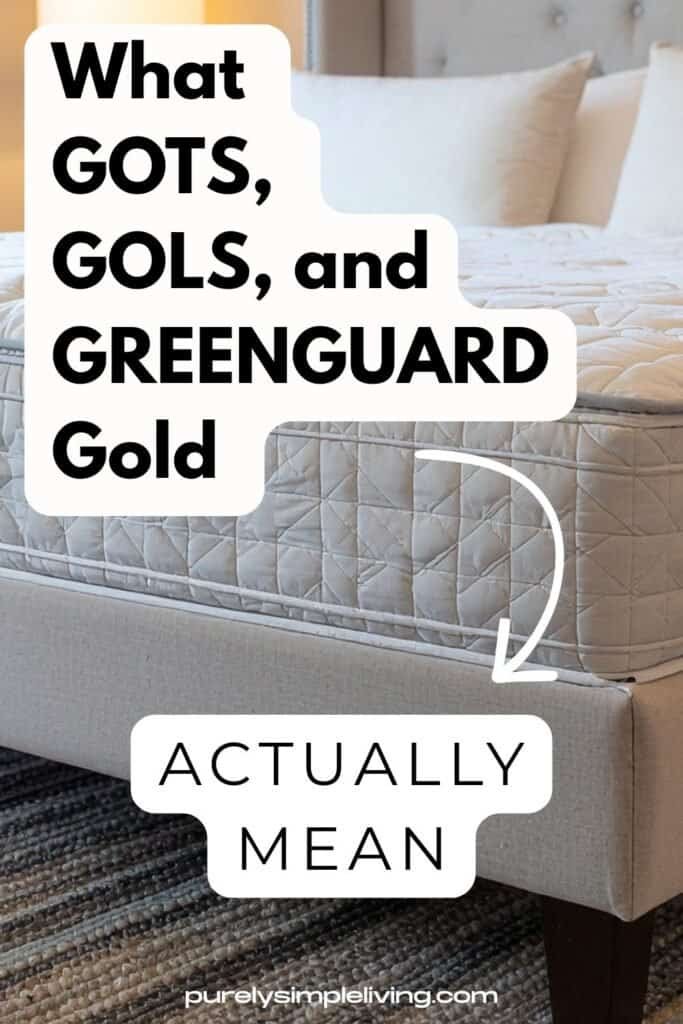
GOTS (Global Organic Textile Standard)
This one matters. GOTS certifies that the cotton and wool in the mattress are organically grown and processed. Covers the entire supply chain, from farm to finished product. Also restricts dyes, finishes, and processing chemicals. If a mattress says “GOTS certified,” the textiles are legit organic.
GOLS (Global Organic Latex Standard)
The latex equivalent of GOTS. GOLS certifies that the latex is made from organically grown rubber trees. Covers harvesting, processing, and manufacturing. If you’re buying a latex mattress and want to know the latex is actually organic (not just “natural”), look for GOLS.
GREENGUARD Gold
Tests the finished product for chemical emissions. The mattress sits in a chamber and they measure what comes off of it. GREENGUARD Gold is the stricter version (originally designed for schools and healthcare). Covers VOCs, formaldehyde, and other pollutants. This is a great “real world” certification because it tests what you’d actually breathe.
OEKO-TEX Standard 100
Tests textiles and materials for over 100 harmful substances. Widely used in Europe. A good indicator that the fabrics won’t leach chemicals into your skin.
What We Recommend Looking For
At minimum: CertiPUR-US (if foam is involved) plus GREENGUARD Gold. Ideally: GOTS for textiles and GOLS for latex, plus GREENGUARD Gold on the finished product. The gold standard (no pun intended) is a mattress that carries GOTS, GOLS, and GREENGUARD Gold together. Those exist. They cost more. They’re worth it.
Foam vs. Latex vs. Innerspring vs. Hybrid
Memory foam and polyurethane foam: The most common mattress material in America, and the most chemically intensive. Even CertiPUR-US certified foam is still petroleum-based. If you’re going non-toxic, foam is the material with the most trade-offs.
Natural latex: Made from the sap of rubber trees (Hevea brasiliensis). Naturally bouncy, supportive, durable (20+ years), and doesn’t off-gas the way foam does. There’s a real difference between natural latex, synthetic latex (petroleum-based, avoid), and blended latex (a mix). Ask for natural or organic. Talalay latex is softer, Dunlop is firmer. Both are fine.
Innerspring: Steel coils with a comfort layer on top. The coils themselves are inert (steel doesn’t off-gas). The concern is what’s in the comfort layer and cover. An innerspring mattress with organic cotton and wool layers is a solid non toxic mattress option, often at a lower price than all-latex.
Hybrid: Coils on the bottom, latex or foam comfort layer on top. The best hybrids combine innerspring support with organic latex comfort. This is where a lot of the best non toxic mattress brands land, because it balances feel, support, and price.
7 Non Toxic Mattress Brands Worth the Investment
We looked at certifications, materials, company transparency, and real owner feedback. These seven are sorted by budget and sleep style to help you find the right fit.
1. Avocado Green Mattress (Hybrid, $1,399-$2,199 Queen)
Avocado is probably the most well-known name in the non toxic mattress space, and for good reason. GOTS certified organic cotton and wool, GOLS certified organic latex, recycled steel coils, GREENGUARD Gold certified. Made in their own Los Angeles factory. Climate Neutral Certified. They also make organic crib mattresses, pillows, and bedding.
Best for: People who want a firm-supportive hybrid that checks every certification box. The pillow top version runs softer if you prefer that.
2. Naturepedic (Multiple Styles, $1,299-$3,499 Queen)
Naturepedic started by making organic crib mattresses, which tells you something about their standards. GOTS, GOLS, GREENGUARD Gold, Made Safe certified. They use organic cotton, organic wool, organic latex, and encased coils. Zero polyurethane foam. Zero flame retardant chemicals. Their EOS model is customizable (each side can be different firmness).
Best for: Couples who need different firmness levels. Parents who want the whole family on the same trusted brand. (Their crib mattresses are exceptional. If you’re setting up a non toxic nursery, start with Naturepedic.)
3. Birch by Helix (Hybrid, $1,048-$1,998 Queen)
Birch is Helix’s organic line. Natural Talalay latex, organic wool, organic cotton, individually wrapped coils. GREENGUARD Gold, GOTS, GOLS certified. It’s a solid mid-range option that doesn’t cut corners on certifications but comes in a few hundred dollars under Avocado and Naturepedic.
Best for: Budget-conscious buyers who still want the full organic certification package.
4. PlushBeds Botanical Bliss (All-Latex, $1,149-$2,848 Queen)
If you want pure latex with zero coils, PlushBeds is the one. GOLS certified organic Dunlop latex, GOTS organic cotton cover, organic wool fire barrier. GREENGUARD Gold. You choose 3 layers of latex in different firmness levels and stack them however you want. Don’t like it? Rearrange the layers.
Best for: People who love latex, want customizable firmness, and prefer no springs.
5. My Green Mattress (Innerspring/Hybrid, $799-$1,499 Queen)
Family-owned, made in Illinois. GOTS certified organic cotton and wool, GOLS certified organic latex, individually pocketed coils. GREENGUARD Gold. The Natural Escape model is their best value: organic materials, solid certifications, and a Queen for under $1,000.
Best for: Families on a real budget who want genuinely organic, certified materials without spending $2,000+.
6. Happsy (All-Organic, $899-$1,699 Queen)
Happsy is a direct-to-consumer organic mattress brand with the same quality standards as premium competitors. GOTS, GOLS, GREENGUARD Gold. Organic cotton, organic wool, organic latex, pocketed coils. They skip retail markup, which is how they keep the price lower.
Best for: People who want full organic certification at a lower price point. Smart move.
7. Saatva Zenhaven (All-Latex, $1,295-$2,595 Queen)
Saatva’s all-Talalay latex option. Flippable (medium-soft on one side, firm on the other), organic cotton cover, natural thistle flame barrier instead of chemical retardants or wool (good for wool allergy folks). CertiPUR-US, OEKO-TEX, GREENGUARD Gold. Not GOTS or GOLS certified, but materials are high quality and the flippable design means you essentially get two mattresses.
Best for: People who want all-latex without wool, or who can’t decide between firm and soft.
The Price Conversation
Real talk. A quality non toxic mattress costs $800-$2,500 for a Queen. Conventional mattresses start at $300-$500. That’s a real difference. We’re not going to pretend it isn’t.
Here’s how we think about it.
You replace a mattress every 8-12 years (conventional foam) or 15-20+ years (organic latex). A $1,400 organic latex mattress over 15 years is $93 per year. A $400 conventional mattress replaced every 8 years is $50 per year. So yes, the organic option costs more per year. About the price of a monthly coffee run.
But the real math is exposure. Eight hours a night, 365 nights a year, for a decade or more. Whatever is in your mattress is in your lungs, on your skin, soaking into your system. For the hours you spend on it, no other piece of furniture even comes close.
If you can’t swing it right now, that’s completely fine. Get an organic mattress topper ($200-$400) or a mattress encasement ($50-$100) as a bridge. Both reduce your direct contact with whatever’s in your current mattress. When it’s time to replace, you’ll know what to look for.
“But My Current Mattress Is Fine”
It might be. If it’s more than 7-8 years old, most of the initial off-gassing has dissipated. The concern shifts to dust mites, accumulated body oils, and mattress degradation (sagging foam breaks down into particles you inhale). An encasement helps with all of that.
If your mattress is newer (bought in the last 2-3 years) and it’s conventional foam, that’s peak off-gassing territory. You can’t un-buy it, but you can ventilate your bedroom aggressively. Open windows daily. Run a HEPA air purifier. Use an organic mattress topper as a barrier layer. Those steps make a real difference while you plan your next purchase.
If you’ve already tackled the big non toxic bedroom swaps (pillows, sheets, air quality), the mattress is the natural next step. It’s the biggest piece left.
A Note on Kids’ Mattresses
Kids are more vulnerable to chemical exposure. Lower body weight, faster breathing rates, developing organs. Everything we’ve said about adult mattresses applies double for children. The crib-to-twin transition is a perfect time to invest in an organic mattress, because they’ll sleep on it for years.
Naturepedic, Avocado, and My Green Mattress all make organic kids’ mattresses. If you’re building out a non toxic nursery or upgrading a toddler room, check those brands first.
The Short Version
Look for GOTS, GOLS, and GREENGUARD Gold certifications. Choose natural latex, organic cotton, and organic wool over polyurethane foam. Expect to spend $800-$2,500 for a Queen. Think of it as a 15-year investment, not a one-time splurge. And if the budget isn’t there yet, bridge the gap with a topper or encasement.
Your bedroom should be the cleanest room in your house. You spend more time there than anywhere else. The mattress is the foundation of all of it. Improving your indoor air quality matters, swapping your sheets matters, running a purifier matters. But the thing your body presses against for a third of every day? That matters most.
Want the Easy Version?
The Non-Toxic Home Starter Kit walks you through every room in your house, including the bedroom. Printable checklists, brand picks, and a swap tracker. Done.