3 New Non-Toxic Spring Cleaning Hacks I’ve Been Trying (and One I’m Giving Up)
You can’t teach new tricks to an old clean freak. Or can you?
Over the last few months, I’ve been feeling uninspired with my cleaning routine, because honestly, it felt like I was doing the same thing every week and still not getting the results I wanted. The house was clean, technically, but it never felt truly fresh.
As you can imagine, this left very little room for the kind of deep, satisfying spring clean that makes you want to throw open every window and admire your baseboards.
However, in trying to shake things up, I’ve discovered that sometimes the simplest changes make the biggest difference. And you don’t need a cabinet full of specialty products to get there.
If you’re in a similar place and have been going through the motions with your spring cleaning, you’re going to love this post. I’m sharing three new non-toxic spring cleaning things I’ve been trying this year.
Hint: There’s also one popular non-toxic cleaning trick I’m giving up, despite the fact that it’s basically a fan favorite on every green living blog out there.
Can you guess what it might be? Read on to find out.
Why Trying New Things in Non-Toxic Spring Cleaning Matters
You may think that you have your non-toxic spring cleaning routine all figured out, and you don’t need to mess with what’s already working.
However, after several years of making my own cleaning products and testing every natural method I could find, I’ve discovered that routines can quietly stop serving you. What worked last spring might not be the best approach this year, especially as new products and techniques keep emerging.
When I first went non-toxic with our cleaning, I followed the same vinegar-and-baking-soda routine for everything. It was fine. Good, even. But I was leaving results on the table because I wasn’t willing to experiment.
The moment I started testing one new thing at a time, our whole routine improved. Faster deep cleans, better results, and way less scrubbing.
Let’s get into the three things I’ve been trying this spring.
1. New Non-Toxic Spring Cleaning Hack: The Overnight Vinegar Soak Method
As an Amazon Associate, I earn from qualifying purchases. This means if you click an Amazon link and buy something, I may earn a small commission at no extra cost to you.
As perfectionists, we’re often prone to scrubbing harder when something isn’t coming clean. Spray, scrub, repeat. Spray, scrub, repeat. My arms were tired and my showerhead still had mineral buildup.
Do you see where I was going wrong?
That’s right, I was relying on force instead of time. The overnight vinegar soak changed everything.
Here’s how it works: fill a plastic bag with white vinegar, tie it around your showerhead or faucet so the fixture is submerged, and leave it overnight. In the morning, remove the bag and wipe. The mineral deposits dissolve on their own.
I’ve been applying this same “let the solution do the work” approach to oven racks (baking soda paste left overnight), stained grout (hydrogen peroxide and baking soda paste for 30 minutes), and even our stainless steel sink.
Next time you feel stuck on a tough cleaning job during your non-toxic spring cleaning, try giving it time instead of elbow grease. If you want a full set of recipes to work with, our 5-ingredient natural cleaning guide is a great starting point.
2. New Non-Toxic Spring Cleaning Hack: The One-Room-Per-Day Method
I know, just like you, I’ve always attacked spring cleaning as a single marathon weekend. Clear the schedule, buy the supplies, clean everything top to bottom in two days. Collapse on the couch. Repeat next year.
My friend Sarah called me out on it. She pointed out that by Sunday afternoon I was exhausted, cutting corners, and skipping the rooms I cared least about. The laundry room hadn’t been deep cleaned in years.
So this year I tried one room per day, spread across two weeks. Just one focused hour per room, with my non-toxic spring cleaning supplies already prepped in a caddy.
Here’s what I discovered:
- Each room actually got a better clean because I wasn’t rushing
- I noticed things I’d been ignoring for months (the dust behind the dresser, the grime on light switch plates)
- I didn’t dread it. One hour is manageable, even on a busy day
- The house stayed cleaner because I was maintaining as I went instead of letting everything pile up for one big event
If you want to take this even further, our zero waste cleaning guide has great ideas for keeping your routine simple and sustainable all year.
3. New Non-Toxic Spring Cleaning Hack: Microfiber Cloths Instead of Paper Towels for Everything
Silly to think that someone who writes about non-toxic living was still burning through paper towels like they were free, but here I was, ripping off sheet after sheet for every window, mirror, and counter.
It dawned on me that I’d been preaching about reducing waste while generating a trash bag full of paper towels every cleaning day.
I bought a pack of color-coded microfiber cloths. Blue for glass. Green for kitchen. Pink for bathrooms. Yellow for dusting. They cost about $12 for a 20-pack and last for hundreds of washes.
Fast forward to today, and I’m happy to say the results are noticeably better. Glass surfaces are streak-free for the first time (paper towels leave microscopic lint). Countertops actually feel clean instead of just wiped down. And I’ve gone from buying paper towels twice a month to basically never.
The environmental win is nice, but honestly? The performance improvement is what sold me. Microfiber just cleans better than paper towels for almost every surface.
Bonus: I’m Giving Up On Essential Oil “Disinfecting” Sprays
Here’s what I’m not doing anymore.
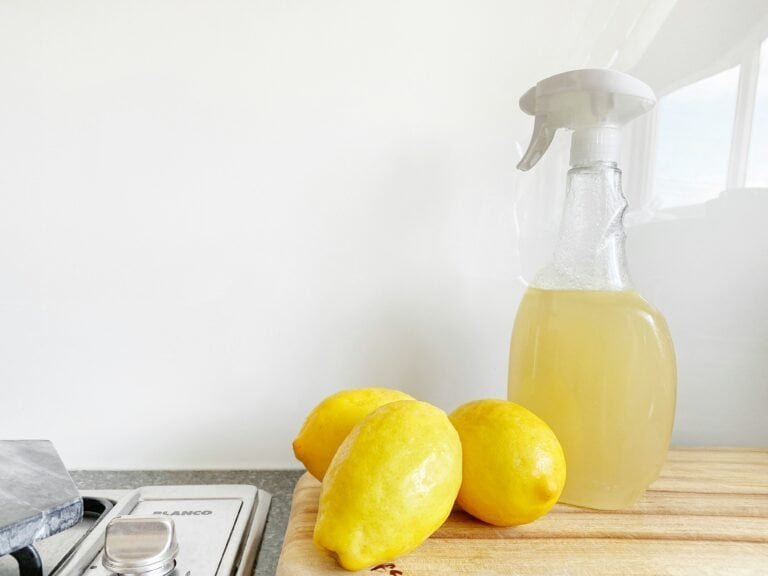
Through my non-toxic spring cleaning experiments, I’ve discovered that essential oil sprays (tea tree, eucalyptus, lemon) marketed as “natural disinfectants” don’t actually disinfect surfaces to any meaningful standard.
I spent way too much money on essential oils thinking they were pulling double duty as cleaners AND germ killers. They smell amazing. They make your house feel fresh. But the research just isn’t there to support the claim that a few drops of tea tree oil in a spray bottle kills bacteria as effectively as, say, hydrogen peroxide or even plain old white vinegar.
This doesn’t mean essential oils are useless. I still add lemon oil to my all-purpose spray because I like the scent. However, I’ve stopped pretending it’s doing the heavy lifting. My actual cleaning power comes from vinegar, baking soda, hydrogen peroxide, and castile soap. The essential oils are just a nice bonus.
What I do instead: I use white vinegar or 3% hydrogen peroxide as my go-to surface cleaner for the kitchen and bathroom (where germ control actually matters), and I save the essential oil sprays for freshening up pillows, couch cushions, and linen closets where fragrance is the point.
Key Takeaways
You can make the most progress with non-toxic spring cleaning when you pick a few new approaches, give them an honest try, and see how they fit into your routine. And if one method isn’t working, you’re better off finding one that actually delivers results instead of forcing it because a blog post told you to.
There are so many ways to get your home fresh and clean without chemicals, and I hope this post has given you a few new ideas to try this season.
Is there a takeaway that was especially helpful for you? Let me know over on Instagram or Pinterest. I’d love to hear what’s working in your home this spring.
Here at Purely Simple Living, we’re all about finding what actually works and sharing it without the guilt trips or the toxic ingredients.